Erlen electronic lab notebook OS
LAUNCH early release · by screening

The lab notebook OS,
for chemists.

Stop renting a subscription. Own the lab notebook itself.

Erlen is an electronic lab notebook you buy once. It runs on your own Cloudflare account (free tier). Neither your records nor your attachments ever pass through our servers. There is no monthly fee.

One-time purchase ¥49,800 (tax included, launch price) Zero monthly fee Data stays inside your own account No dependence on outside services Invite-based multi-user No refunds — so take the fit check first
¥0/moRunning cost (it fits inside the Cloudflare free tier)
213testsBundled unit tests (npm test runs them all)
41solventsSolvent presets, loaded into the reagent master in one press
30–60minTypical first-time setup (only minutes of it are yours)
3rolesowner / editor / viewer, by invitation

why

Paper, subscriptions, open source — none of them had room for this.

If you have ever seriously hunted for somewhere to keep lab records, these three options will look familiar.

paper

A paper notebook cannot be searched

"I'm sure we ran that reaction under similar conditions last year." To confirm it you scan the spines on the shelf and turn pages. Writing is fast; finding is fatally slow. And when a student graduates, their notebook becomes a black box in practice.

saas

A full-featured ELN stays borrowed

Almost every ELN you can actually deploy is either a subscription or a "contact us" enterprise product, costing tens to hundreds of thousands of yen per person per year. You can only use it while the grant lasts. The moment the contract ends, everything you piled up in there moves out of reach.

oss

Free open source turns operations into a job

eLabFTW and Chemotion are fine pieces of software. But the UI is in English, you stand up your own Linux server, and you keep the updates and backups turning. Researchers who can do that are usually already doing it.

— the middle ground did not exist.

An electronic lab notebook that you buy once, and where nobody has to babysit a server, simply was not on the market. Erlen is the product placed in that gap.

definition

Why this product calls itself an "OS"

An OS here means not a finished application, but a foundation you grow together with an AI to fit your own lab.

An app is something you learn to use You fit your research into the fields somebody else chose. Where a field does not fit, your options are to put up with it or not use it.
An OS is something you rebuild to fit you With Erlen the whole codebase is in your hands. Add fields, add formulas, change the layout of a report. The right to rebuild comes with it from day one.
You and the AI do the rebuilding Claude Code does the hands-on work. Ask it in plain language to "add an internal standard column to the reaction table" and the code and the tests both grow.
To be clear

As delivered, it is already complete as a lab notebook. Grow it whenever you feel like it, or never. Calling it an OS means only that the room to grow has not been closed off.

three reversals

Three reversals

What Erlen does is not add features. It turns inside out the way you hold the tool called an electronic lab notebook.

reversal 01

The monthly fee goes to zero

Erlen runs on the free tier of the buyer's own Cloudflare account. Workers, D1 (the database), R2 (file storage) — for an individual or a small lab, usage fits inside the free tier. There is no monthly fee to us and no rented CPU time.

A subscription is a tool you may use for as long as you keep paying. Erlen is your own tool from the moment you buy it. The difference starts to bite in year three.

subscription Tens to hundreds of thousands of yen per person per year. It grows with headcount. Stop paying and it stops.
erlen Pay ¥49,800 once and you are done. Headcount changes nothing. There is nothing to stop.
reversal 02

The data stays with you

Lab records and attached spectra alike are placed only inside your own account. Nothing routes through our servers. We cannot read the contents, and we cannot aggregate them.

If a vendor raises prices, changes direction, or shuts down, your data does not move a millimetre. Erlen has no concept of "closing your account", because there is nobody to cancel with. When someone leaves or graduates, the only thing that moves is who owns the Cloudflare account; the records stay put.

It also depends on no outside services. Authentication, the database, and file storage are done entirely with Cloudflare and our own implementation. When somebody else's service changes its terms, raises prices, or folds, Erlen keeps running. The only outbound call is to PubChem (the public API of the US NIH/NLM) when looking up a compound.

subscription Records sit on the vendor's servers. Migrating depends on how good their export happens to be.
erlen D1 and R2 are your assets. The bundled skill writes the whole thing out locally whenever you want.
reversal 03

Missing features get added by the AI

When a SaaS lacks a feature, all you can do is file a request and wait. You are not the one setting the priorities.

With Erlen the whole codebase is in your hands. Tell Claude Code "add an internal standard column to the reaction table" or "match this report to our institution's format", and it grows. The 213 bundled tests exist so that when the AI changes something, a machine can judge that nothing broke.

subscription Request form → under consideration → next release. Sometimes never.
erlen Ask on the spot → the AI implements it → deploy once the tests are green. You make the call.

features

What it does

The design rule is: create no new work in the name of going digital. Faster to write than paper, faster to find than paper. Nothing else was added.

core 01

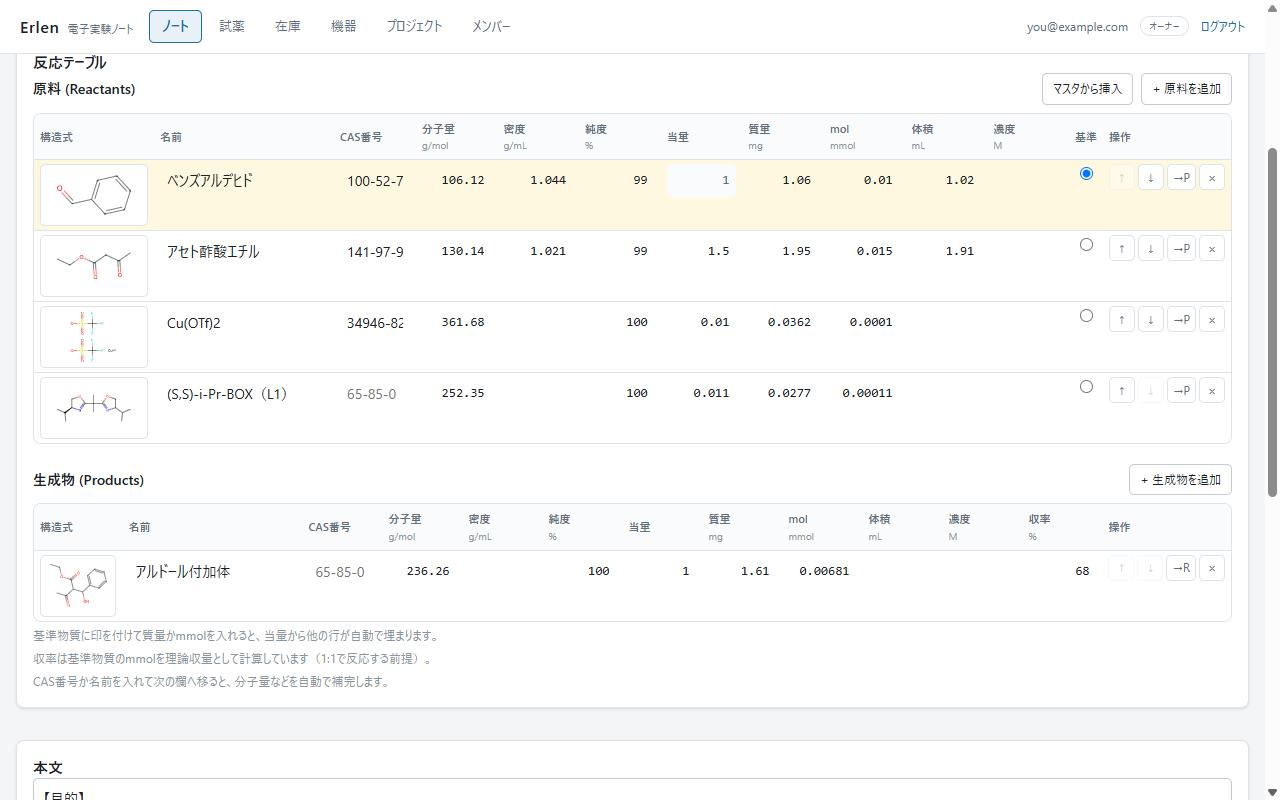
Reaction table: put in equivalents, and the rest fills itself

List your reagents, enter the amount of substrate you are charging and the equivalents for each reagent. That alone computes moles, required amounts, and theoretical yield from one another. You can start anywhere: derive equivalents from a mass, or a required mass from equivalents. Enter the isolated amount of product and the yield appears immediately.

On a day you want to double the scale, you rewrite the substrate amount and nothing else. Copying the Excel sheet every time, repairing the references, and charging the flask without noticing the drift — that goes away.

The reaction table computing equivalents, theoretical yield, and yield automatically
core 02

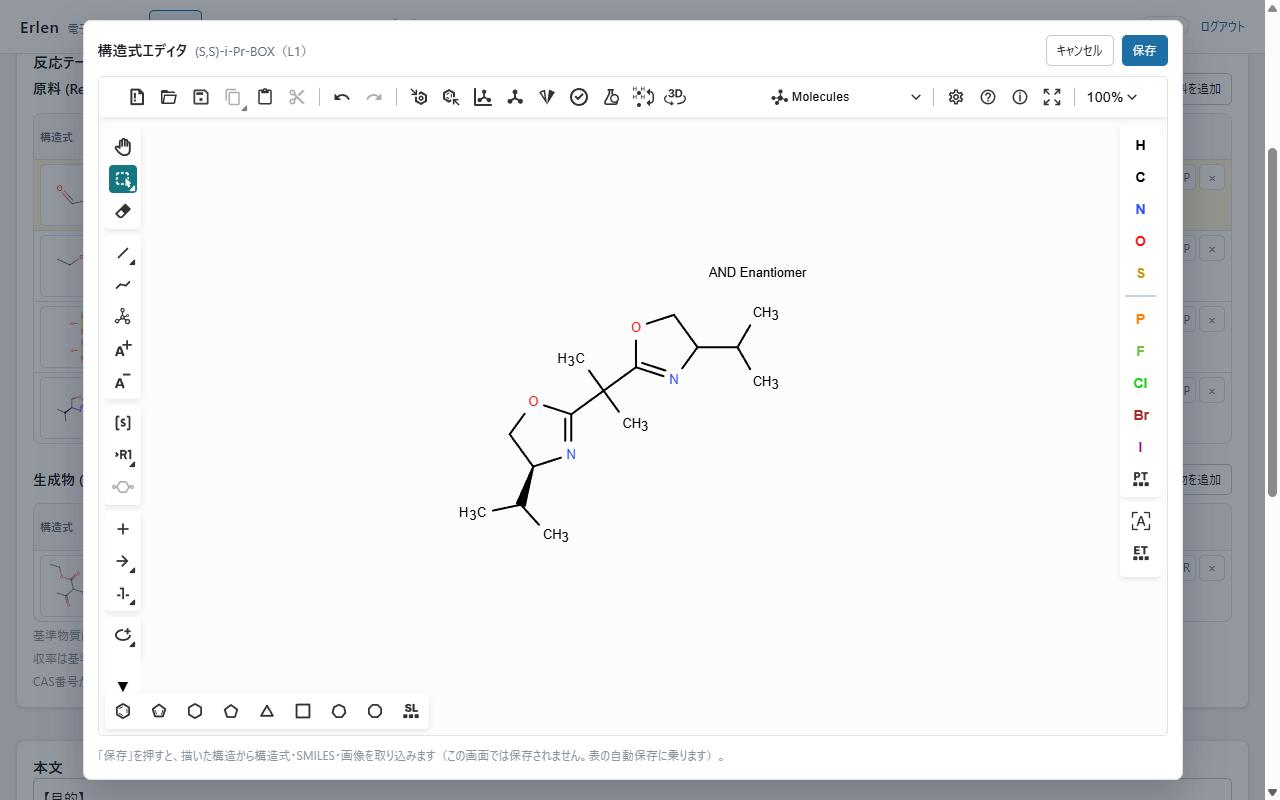
Chemical structures: draw in Ketcher inside the page, and keep it there

EPAM's structure editor Ketcher is bundled (Apache License 2.0). Nothing is sent to an outside service; it runs inside your own Worker. What you draw is saved to the page as SMILES / molfile, and you can reopen and redraw it later.

Type a compound name or a CAS number and PubChem fills in the molecular formula, molecular weight, and more (cached for 30 days; if the lookup fails you simply type the values and carry on).

The Ketcher structure editor open inside a page, with a molecule being drawn
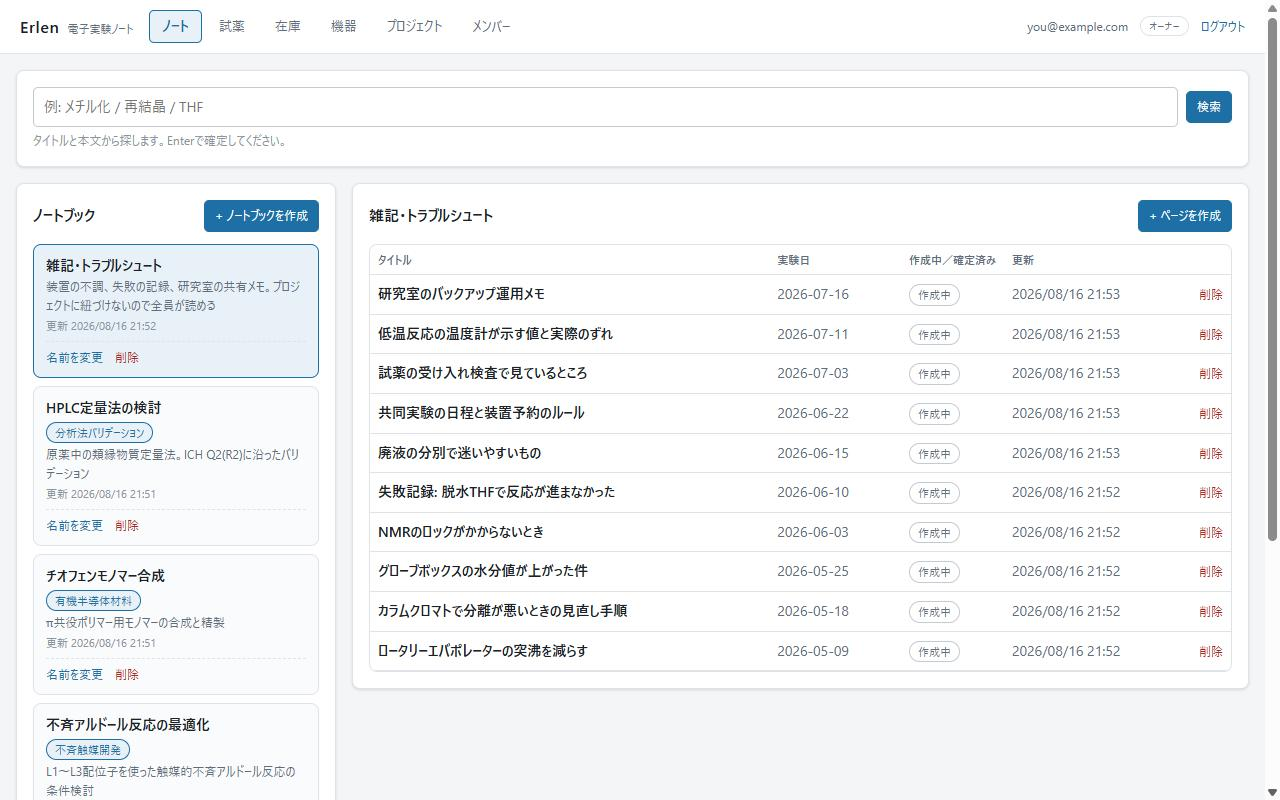
Lab notebookTwo levels: notebook → page. Autosave. Aim, procedure, and discussion at a grain you can finish the same day.
Full-text search (Japanese included)SQLite FTS5 with trigrams, so words in the middle of Japanese text are found too. "Where were those conditions?" takes seconds.
Attachments in R2Attach spectra, PDFs, and raw data to a page. Up to 25 MB per file by default, stored in your own R2.
Printable reportPages laid out as a single HTML document. Print to PDF from the browser and bind it. For reports and thesis appendices.
Audit trail (append only)Page revisions recorded automatically. Who changed what and when accumulates rather than being overwritten.
Invite-based multi-userGoogle login. Three roles: owner / editor / viewer. Share across a lab and drop graduates down to viewer.
Reagent master and stockA reagent register and lot-level stock. 41 solvent presets bundled; import them and edit freely.
Equipment managementAn equipment register (maker, model, asset number, inspections), with sample presets.
An overview of the notebook list and the page editor

manifest

What is inside the zip

What arrives after purchase is one zip file. Nothing is "coming later", and nothing is a paid plugin. This list is all of it.

The whole programThe Worker server code (plain JS with no dependencies) and the pre-built UI (React). You may modify it freely.
SETUP.md (a manual written for the AI)About 30,000 characters. Not written for a human to read, but for an AI to read and act on: order of operations, safety rules, and the branches to take when something fails.
Three Claude Code skillseln-setup (first build) / eln-update (applying a new version) / eln-backup (export and restore). Say "set it up" and they start.
Two guide HTML filesFor humans: "first-time setup" and "applying an update", with the prompts you hand to the AI laid out with copy buttons. You can read the full text here before buying.
EULA (licence)Use and modification by the purchaser, in one lab, are unrestricted. Redistribution and resale are prohibited. The full text is readable before purchase.
An AI operating charterSafety rules for letting an AI touch this product (migrations are append-only, destructive operations need human approval, and so on). The AI reads it first.
41 solvent presetsSeed data for the solvents a lab actually uses. One button loads them into the reagent master, and you can edit or delete them afterwards.
Equipment presetsSamples of the equipment common in a synthesis lab. Rewrite them to match your own instruments.
213 unit testsReaction calculations, permissions, authentication, tenant isolation. After you modify something, a machine judges that nothing broke.
zip 9.3MB tests 213 solvent presets 41 Windows / macOS both npm dependency: wrangler only

requirements

Requirements (we are not hiding the hurdles)

This is not a product that anyone can buy and use straight away. Without the items below, things are likely to go badly.

What you needWhat it is forCost
Claude Code The working AI you hand setup and operations to. A Fable-class model is recommended (a Sonnet-class model gets through too, but recovering when it gets stuck is a different experience). Separate subscription
A Cloudflare account Where the notebook runs. Workers / D1 / R2. Signing up needs no credit card. Runs on the free tier
A Google account Used to log in to the notebook. For a lab, use the PI's account. Free
Node.js 22.5 or later Needed for the AI to run commands. If it is missing, the AI walks you through installing it. Free
OS Windows and macOS both supported. Verified end to end on real accounts on both.
step 1Open the unzipped folder in Claude Code
step 2Ask it to "please set this up"
step 3Log in yourself to Cloudflare and Google
step 4Paste one secret value
step 5Your notebook opens at your own URL
First-time setup takes 30 to 60 minutes, and your part of it is logging in and pasting.

The AI runs every command. If you want to see what happens before you commit, the guide that ships with the product is published as it is. Judge for yourself, before buying, whether this looks doable.

fit

Who it suits, and who it does not

Because this is a digital product with no refunds, we decided in advance not to sell it to people it does not suit. If the right-hand column describes you, please don't buy it.

It suits you if

  • You are a researcher who wants to hold their own data, and cannot stand a vendor deciding where your records live.
  • You are a PI who wants to share across a lab — invite students and separate their roles, with no per-seat billing.
  • You want to grow your tools with an AI: you use Claude Code routinely and think of missing features as something you add.
  • You want to pull into one place records scattered across paper, Excel, and cloud storage.
  • You have started questioning what your subscriptions have cost in total.

It does not suit you if

  • Your site requires GxP / CSV regulatory conformity. Erlen keeps a revision history (audit trail), but it is not a product that guarantees regulatory conformity. Do not use it for work subject to inspection.
  • You will not touch a command line at all. The AI does the running, but this is not for someone who cannot bear watching that screen.
  • You need attentive support. The one-time price assumes no support is attached. There is no help desk.
  • You do not plan to use Claude Code. This product is built to be handed to an AI.
  • Your institution's rules prevent you from putting data in an outside cloud.

who made it

About the person who made this

Chemistry is my day job. The person building this is not a marketer or a SaaS vendor, but someone on the side of the bench who writes a lab notebook every day.

This is my third electronic lab notebook. The first was the web application ProcessELN (processeln.com), the second the iOS app Chemical Lab Note, and both are released and available on the App Store.

Erlen stands on what those two taught me: the calculation logic of the chemistry domain, the notebook → page data model, and the owner / editor / viewer split of permissions — every one of them took its shape in real use. None of it was designed from scratch on a hunch.

The foundation, however, was rebuilt completely. Erlen is done entirely with Cloudflare (Workers / D1 / R2) and our own implementation, and it depends on no outside cloud service at all. Even the login mechanism is our own. Having no dependencies means nothing stops because another company decided so, nothing gets repriced, and no change of terms drags you along.

What running those two taught me was that the problem was never "not enough features" — it was that the place and the manner of holding the records were wrong. Erlen is the third notebook, rebuilt from that conclusion. I made it to use it myself, every day. It has been verified end to end on real accounts, and my own records now live on it. Even if it never sells, I will keep using it, so at least there is no risk of updates stopping.

price

Price

A one-time purchase. No add-on costs, no per-seat billing, no renewal fee.

LAUNCH launch price
¥49,800 tax included · one-time purchase

The regular version is planned at ¥79,800 ¥79,800 (tax included). This price ends as soon as the early-release places are filled. We do not refund the difference after the rise.

One-time purchase. Pay once and there is no monthly or annual fee afterwards.
No per-seat billing. Invite as many lab members as you like; the price does not change.
Running cost is zero too. It works within the Cloudflare free tier (any metered charges beyond it are between you and Cloudflare).
There is no support. Investigating defects and resolving environment-specific issues is done by the purchaser, with the bundled documentation and an AI.
Individual support is sold separately (¥20,000 per hour). Only for those who want it, only when they want it.
Updates are not guaranteed. When we release one, it is free (we have no plan to charge for updates).
No refunds

Because this is a downloadable digital product, we cannot accept returns or refunds after purchase. That is exactly why the fit check and the screening come first. When it does not suit you, we are the ones who say "please don't buy this".

Claude Code costs are not included

Fees for the working AI are between you and Anthropic. They are not part of Erlen's price.

Apply for the early release Take the fit check first
flow 1Fit check (30 seconds, 7 questions)
flow 2Application form
flow 3Automatic verdict (5 conditions)
flow 4Payment (only for those who pass)
flow 5The download URL for the zip arrives by email

faq

Frequently asked questions

Do I need to know how to program?

You do not need to know how to write code. The AI writes it.

What you do need is enough tolerance to watch the screen while the AI runs commands. If a scrolling black terminal freezes you, this is not for you. During setup your part is three things: logging in to Cloudflare and Google, approving what it proposes, and pasting a secret value.

What exactly does "no support" mean?

It means there is no help desk. Email us and there is no reply. We do not take defect reports either.

Instead, we ship the product in a state where an AI can investigate and fix it: a 30,000-character SETUP.md, an AI operating charter, 213 tests, and three skills. When you are stuck, paste the error text straight into Claude Code. For the times that still does not resolve it, individual support is available separately (¥20,000 per hour).

Is the Cloudflare free tier enough?

For an individual or a small lab, yes. The free tier gives you 5 GB on D1 and 10 GB on R2.

The text of a lab record is a few kilobytes per page, so 5 GB is on the order of hundreds of thousands of text-only pages. Attachments are what actually bite: 10 GB on R2 is about 5,000 spectra at 2 MB each. If you outgrow it, you can move to Cloudflare's metered pricing (R2 is roughly $0.015 per GB per month). That contract is between you and Cloudflare; we are not involved.

Where is my data stored?

Only inside your own Cloudflare account. Text records go into D1 (the database), attachments into R2 (file storage).

Nothing routes through our servers. We cannot read the contents and we cannot aggregate usage (no mechanism for that exists in the product). The only outbound call is to PubChem (the public API of the US NIH/NLM) when looking up compound information.

What happens when I leave or graduate?

As long as the owner of the Cloudflare account does not change, the records stay exactly where they are. Erlen has no "close account" and no "cancel", because there is nobody to cancel with.

If you use it as a lab, we suggest putting the Cloudflare account in the name of the lab's representative. To hand over an instance built on a personal account, the bundled eln-backup skill exports everything, and you rebuild on the new account and load it back in.

Can several people use it?

Yes. It is invite-based multi-user, with three roles: owner / editor / viewer.

The owner invites, editors can write, viewers can only read — so you can drop graduates down to viewer. There is no extra charge per person. Invitation emails are not sent automatically, so you copy the text shown on screen and pass it to the person yourself (having no email-sending machinery is part of depending on no outside services).

Is it GxP compliant? Can I use it under inspection?

It is not, and please do not.

Erlen automatically records page revisions (who changed what and when) in append-only form, but that exists for traceability as a research record, not to guarantee conformity with GxP, CSV, 21 CFR Part 11, or similar regulatory requirements. There are no validation documents and no supplier audits. For work subject to inspection, choose a commercial ELN that guarantees conformity. The fit check flags this condition as "not for you" outright.

Can I migrate from my paper notebooks or Excel?

No automatic migration tool is bundled. That said, migration is exactly what an AI is good at.

For a reagent register in Excel or CSV, ask Claude Code to "load this CSV into the reagent master" and it writes a script on the spot and pushes the data in (the API and the database schema are both in your hands). For paper notebooks, we suggest starting with "from today, new records go into Erlen", and back-filling only the old entries you actually need. Trying to move everything usually stalls halfway.

Do updates cost money?

They are free — but we do not guarantee that they will come (the EULA says so too).

When we release one, purchasers get a download URL. The bundled eln-update skill applies it, and your settings, lab records, attachments, and already-stored secrets are not overwritten (migrations are append-only by design). Since the person who made it uses it every day, in practice it will keep getting fixed.

Are Claude Code costs extra?

Yes. They are not included in Erlen's price; that is a contract between you and Anthropic.

First-time setup alone consumes little, but once you start adding features it adds up accordingly. We recommend a Fable-class model. Cheaper models get through too, but whether it can recover on its own when it gets stuck changes the experience enormously.

Can I get a refund?

No. Because this is a downloadable digital product, we cannot accept any return or refund after purchase.

In exchange, everything you need to check beforehand is out in the open: the 7-question fit check, the bundled guide published in full, this list, and the screening. If we judge that it does not suit you, we are the ones who say "please don't buy this".

Can I use it commercially, or roll it out across my company or university?

The purchaser (an individual, or one lab / one business) may freely use it for their own work. Modification is free too, and there is no restriction on using your modified version yourself. That includes work use in a corporate research centre.

What is prohibited is redistribution, resale, lending, and posting to a public repository, as well as selling a competing product of which this is a substantial part, or offering it as a SaaS. If you want another lab to have it too, that lab buys its own copy.

What are the licences for the bundled Ketcher and for PubChem?

The structure editor Ketcher is made by EPAM Systems and is under Apache License 2.0. It is provided under the terms of Apache-2.0 rather than this product's EULA, and the licence notice ships with it.

PubChem is a public service of the US NIH/NLM. Follow PubChem's policies for the data you retrieve. The solvent and equipment presets are examples of seed data. Physical properties and regulatory classifications vary by grade and supplier, so in practice always confirm against primary sources such as the SDS.

last call

Stop renting your lab notebook.

The early release is by screening. Take the fit check before applying and the verdict carries over, shortening the form. If we judge that it does not suit you, we tell you why and what to consider instead.

One-time purchase ¥49,800 (tax included, launch price) Regular price ¥79,800 planned No refunds No support